
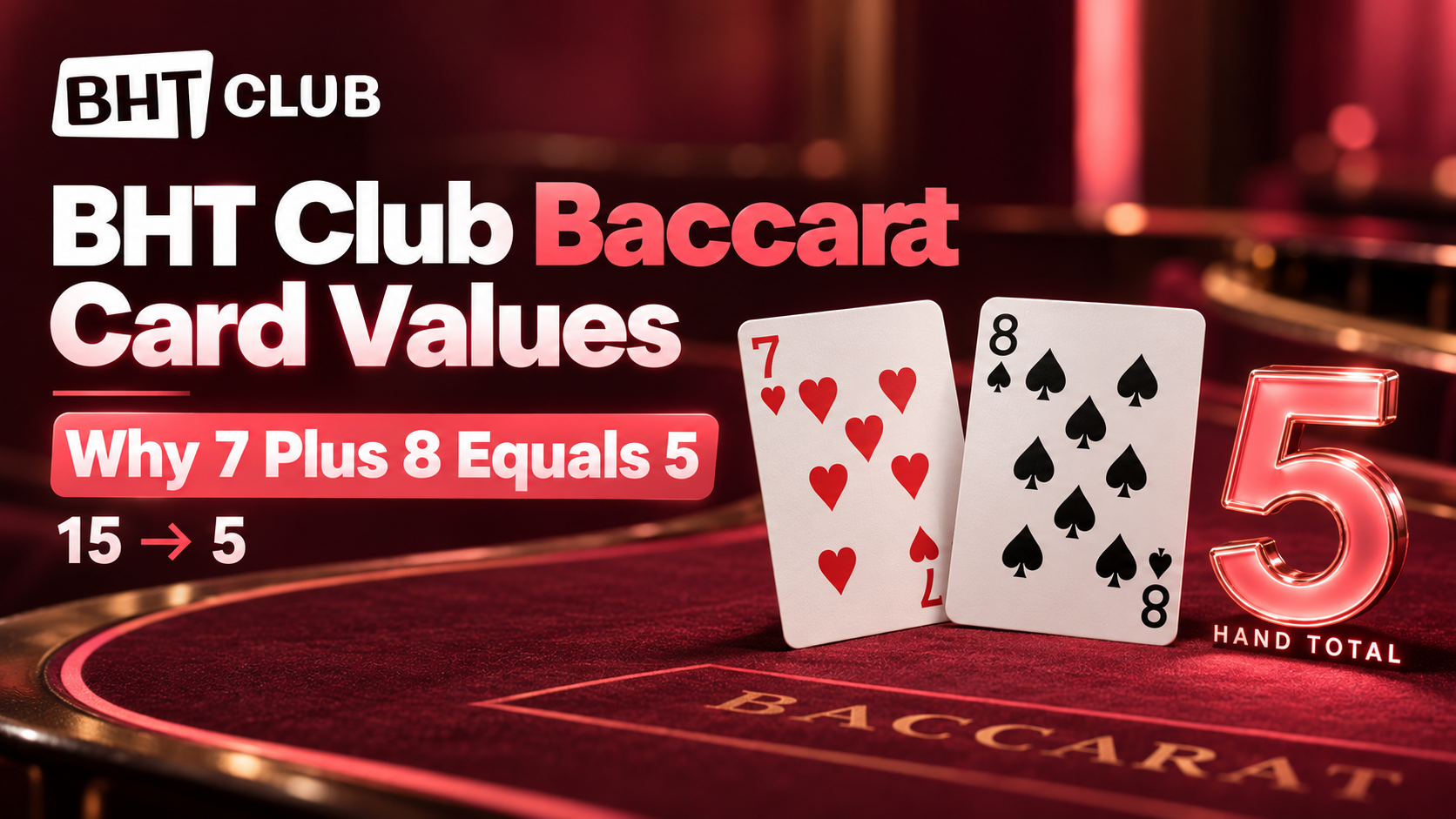
BHT Club Baccarat Card Values: Why 7 Plus 8 Equals 5
You see a 7 and an 8 on the baccarat table. You add them correctly and get 15. Then the score beside the hand shows 5. Has something gone wrong? No. You have just met the rule that makes baccarat scoring different from ordinary addition.
BHT Club Baccarat card values become easy to follow once you remember one idea: add the card points, then keep only the last digit. Seven plus eight still makes fifteen, but the baccarat hand scores five.
That small change explains much of the game. You do not need difficult maths, poker rankings or a long list of combinations to understand the total. This BHT Club guide explains standard baccarat scoring with clear examples, helping you follow the cards with confidence. Check the rules inside your selected table for its particular version and payment conditions.
Why Seven Plus Eight Scores Five
Baccarat uses a final score from zero to nine. When your addition produces two digits, the digit on the right becomes the hand score. The tens are left out.
Here is the title example:
- The first card is 7, worth seven points.
- The second card is 8, worth eight points.
- Seven plus eight makes 15.
- Keep the final digit: the hand scores 5.
You are not changing the value of either card. You are converting the combined points into a baccarat total.
The same method turns 12 into 2, 17 into 7 and 20 into 0. A higher ordinary sum therefore does not always produce a higher baccarat score.
For BHT Club readers, this is the most useful place to begin. Once the last-digit rule becomes familiar, the displayed totals feel logical. You can spend your attention following the round instead of wondering why the numbers appear to disagree.
The Baccarat Card Values Table
Standard baccarat has three simple card groups. Number cards from two through nine keep their printed values, an ace contributes one, and tens plus picture cards contribute zero. The Pennsylvania Code’s baccarat scoring rules confirm this system and the single-digit total.
| Card | Baccarat points |
|---|---|
| Ace | 1 |
| 2 | 2 |
| 3 | 3 |
| 4 | 4 |
| 5 | 5 |
| 6 | 6 |
| 7 | 7 |
| 8 | 8 |
| 9 | 9 |
| 10 | 0 |
| Jack | 0 |
| Queen | 0 |
| King | 0 |
Read the card value before doing the addition. This avoids the common mistake of treating an ace as eleven or a king as ten.
Suits do not change the ordinary hand total. A seven of hearts and a seven of clubs contribute the same points. Red and black cards also follow the same scoring method.
Why Face Cards Count as Zero
A king looks impressive, especially if you know poker or Teen Patti. In baccarat, its ordinary scoring value is zero. The same is true for a queen and a jack.
Think of BHT Club Baccarat face cards as cards that add no points to the hand total. They are still part of the dealt hand; they simply contribute zero to this calculation.
A queen with a seven scores seven. A jack with an ace scores one. A king with a ten scores zero because both cards contribute zero.
This also means a picture card does not automatically make a hand strong or weak. King plus nine scores nine, while king plus two scores two. The other card matters.
Keep ordinary scoring separate from any special wager rules. A side bet may consider card ranks or combinations, but that does not turn a king into extra points for the main hand comparison.
How to Calculate Bht Club Baccarat Scoring Any Hand Total
Use the same three actions every time: identify the values, add them and keep the last digit.
Identify the values
Replace each card with its baccarat points. For example, Queen and 6 becomes zero and six. Ace and 8 becomes one and eight.
Add the points
Do normal addition. There is no need to guess the score by looking at the artwork or counting how many high cards appear.
Keep the last digit
If the sum is already below ten, it stays as it is. If it has two digits, keep the digit on the right.
For a BHT Club Baccarat hand total of 18, the score is eight. For a total of 10, the score is zero. You do not keep subtracting until you reach a preferred number; the rule gives one fixed answer.
This method also works when a third card is dealt. Every card contributes its assigned points before the final score is read.
Read the score aloud while learning
A useful way to practise is to describe the calculation in one short sentence. For eight and six, say: “Eight plus six is fourteen, so the score is four.” For a king and seven, say: “Zero plus seven is seven.” This connects the visible cards with the displayed number.
You can practise with ordinary playing cards away from any paid table. Deal two cards, assign their baccarat values and calculate the result. There is no need to place a wager to learn the arithmetic.
After a few examples, compare two practice hands. Check each total separately and carefully before identifying the higher score. This keeps your attention on the calculation and helps prevent mixing cards from opposite sides during a round.
Player and Banker Use the Same Maths
Player and Banker are the names of the two hands. They do not have different card values. An ace counts as one on either side, and a queen counts as zero on either side.
Compare the completed hand scores to identify the main result. Since both scores fall between zero and nine, the higher score is closer to nine. Equal final scores mean a tie.
Imagine a completed Player hand scoring seven and a completed Banker hand scoring six. Player wins that comparison. Reverse those scores and Banker wins. The label does not override the numbers.
There is also no poker-style ranking of a pair above an ordinary total. Two fours score eight because four plus four equals eight. Their matching ranks do not automatically defeat a hand scoring nine.
This consistent scoring is a welcome feature for beginners. Learn one set of card values and you can read both sides of the table.
Worked Baccarat Score Examples
The following BHT Club Baccarat score examples are teaching examples, not records of actual rounds. Some illustrate opening totals that may require further cards before settlement.
| Cards | Addition using baccarat values | Score |
|---|---|---|
| 7 and 8 | 7 + 8 = 15 | 5 |
| 9 and 6 | 9 + 6 = 15 | 5 |
| 4 and 5 | 4 + 5 = 9 | 9 |
| Ace and 7 | 1 + 7 = 8 | 8 |
| Queen and 9 | 0 + 9 = 9 | 9 |
| King and Jack | 0 + 0 = 0 | 0 |
| 6 and 4 | 6 + 4 = 10 | 0 |
| 8 and 8 | 8 + 8 = 16 | 6 |
Different cards can produce the same score
Seven with eight and nine with six both score five. Baccarat compares the resulting points, so different-looking combinations can finish equal.
A smaller sum can produce a higher score
Four plus five gives nine. Eight plus eight gives sixteen, which becomes six. The first hand has fewer ordinary points but the higher baccarat score.
Zero-value cards can sit beside strong totals
Queen plus nine scores nine. The queen contributes nothing, but it does not reduce the nine. This is why judging a hand by its picture cards can be misleading.
A total of ten is zero
Six plus four is ten, and the final digit is zero. Zero is a valid score. It does not mean that the cards were missed or the calculation failed.
Natural Eight and Natural Nine
In standard punto banco baccarat, an opening two-card total of eight or nine is called a natural. The word describes when that score occurs, as well as its value.
If either opening hand has a natural, the standard round ends without additional cards. The two opening totals are compared. A natural nine beats a natural eight, while matching natural totals produce a tie.
Examples include ace plus seven for a natural eight and queen plus nine for a natural nine. Nine plus nine totals eighteen, so it also makes a natural eight.
A natural eight is therefore strong, but it is not an automatic winning result. The other hand may have nine or an equal eight.
A three-card total of nine still scores nine, but it is not an opening natural. Keeping this distinction clear helps you understand why one round stops after two cards while another continues.
What Happens When a Third Card Arrives?
A third card changes the total through the same addition rule. You add its value and keep the final digit again.
For example, an opening hand of two and three scores five. If it receives a four, the combined points become nine. The final score is nine.
If that same opening hand receives an eight instead, the sum becomes thirteen and the score becomes three. An extra card does not always improve a hand.
Scoring and drawing are separate questions
Scoring tells you what the cards are worth. Drawing rules determine whether another card must be dealt. In standard punto banco, these decisions follow fixed rules rather than a personal choice to request a better card.
Player and Banker have different drawing conditions even though their card values are identical. The Banker decision can depend on the Player’s third card.
For this guide, focus on calculating the score once the cards are present. Read your table’s drawing rules separately before trying to explain why a particular third card was dealt.
Reading a Baccarat Round Clearly
When opening a baccarat table through BHT Club, first check its name and rule information. This article explains standard scoring; it does not confirm the provider, available tables or special features inside your account.
Follow one round from the opening deal to the completed hands. Identify which cards belong to Player and which belong to Banker. Read each card’s points before checking the displayed total.
If another card arrives, update only the relevant hand. Once dealing is complete, compare the final scores. This simple order keeps the round understandable even when the interface includes animations or extra information.
If a displayed score seems surprising, write down the cards and calculate again. Many apparent differences come from counting an ace incorrectly or forgetting that a ten contributes zero.
For an unresolved record question, keep the round reference and relevant screenshot for customer support. Never share passwords or verification codes when asking for an explanation.
Hand Scores and Payouts Are Different
A hand score answers which side has the higher completed total. It does not tell you the amount returned on a wager.
For example, a score of nine does not mean a nine-times payout. Likewise, a winning score of five does not mean five times your stake. Payment follows the selected wager and the table’s published conditions.
Check commission rules, tie treatment and any special settlement conditions separately. A table description such as commission-free should not be taken to mean every winning outcome pays identically to another version.
Side bets also need their own explanation. They may depend on pairs or other combinations rather than only the main hand total.
Understanding BHT Club Baccarat card values helps you read the result accurately. It does not predict the next deal or guarantee a return. If participating with money, use only an affordable entertainment budget and stop at your chosen limit.
Make Every Card Easier to Understand
BHT Club Baccarat becomes easier to follow when the scoring feels familiar. Start with the three value groups, add the points and keep the last digit. Then wait for completed hands before comparing the result.
Seven plus eight still makes fifteen in ordinary maths. Bht Club Baccarat simply reads that total as five. Once this clicks, face cards, natural totals and third-card changes become much less confusing.
Keep this guide handy while reviewing the table rules. Clear understanding lets you appreciate the card-by-card flow, recognise the final score and ask useful questions whenever something needs explaining.