BHT Club Wingo 30 Seconds vs 1 Minute: What Changes Beyond the Timer?
Understanding the Two Wingo Formats
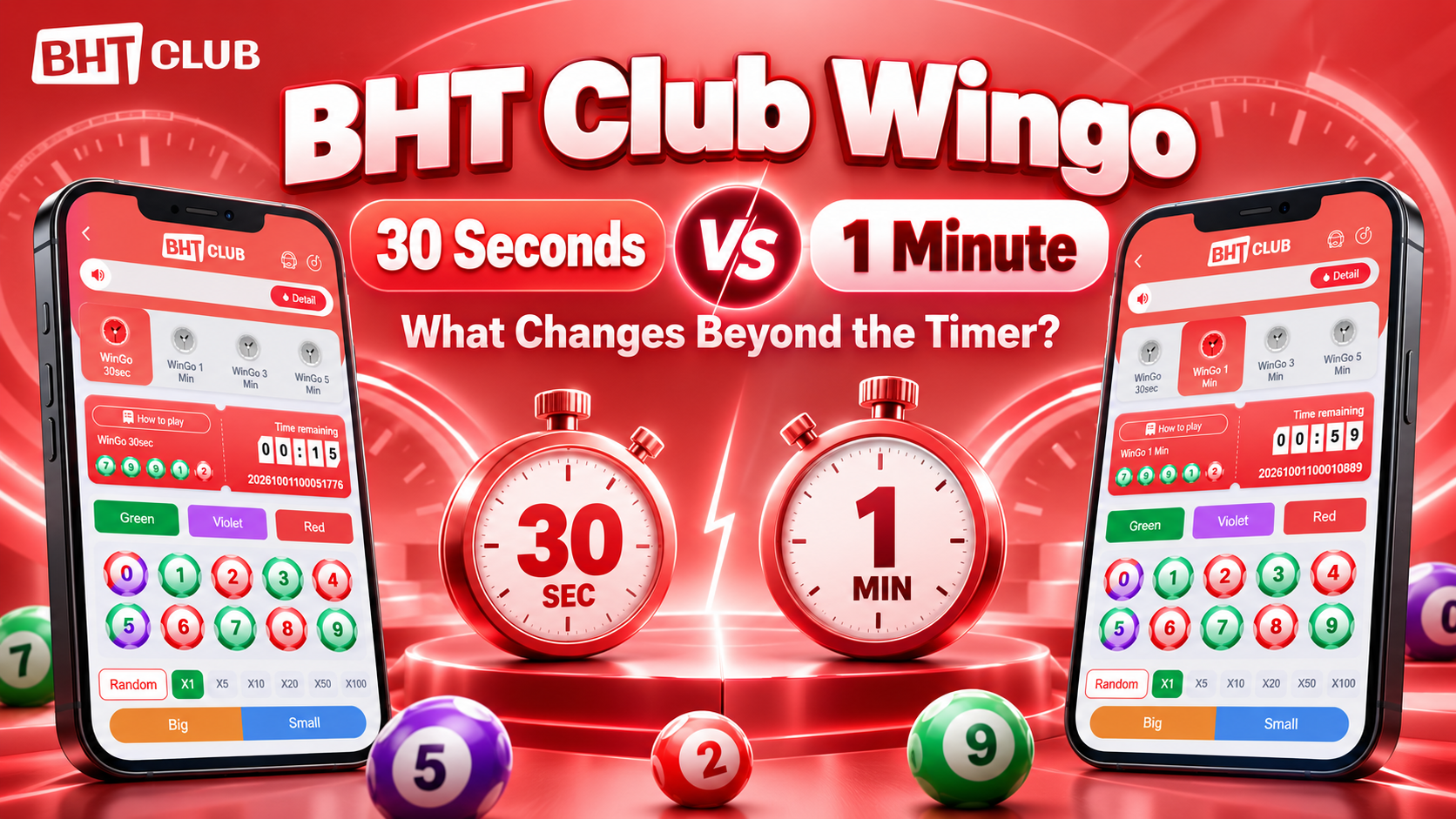
BHT Club lottery page lists Wingo in several timeframes, including 30 seconds and 1 minute. Its published Wingo rules describe a number result connected to selection categories such as colour and Big or Small.
The room label identifies the scheduled round duration. It does not mean that every person opening the room receives a fresh, full countdown. If you arrive halfway through an active round, only the remaining time is available.
Think of each round as a separate entry with its own identifier. Your selection belongs to the round shown in your accepted order, rather than whichever result happens to be newest when you look again.
This distinction makes the BHT Club Wingo Game easier to understand. First identify the room, then the active round, and finally the information attached to your own order.
The Main Differences at a Glance
The following comparison uses uninterrupted scheduled intervals. Actual availability, order acceptance and screen updates depend on the live platform.
| Comparison point | Bht Club Wingo 30 seconds | Bht Club Wingo 1 minute |
|---|---|---|
| Scheduled round duration | 30 seconds | 60 seconds |
| Scheduled rounds in ten minutes | 20 | 10 |
| Scheduled rounds in one hour | 120 | 60 |
| General rhythm | More frequent transitions | More space between transitions |
| Time to review between results | Shorter | Longer |
| Same stake on every round | More total money staked per hour | Less total money staked per hour |
| Better odds from timer alone | Not established | Not established |
These figures are calculations from the stated intervals, not a recommendation to join every round. Watching without placing an order is a useful way to understand the screen.
The strongest practical distinction is the amount of activity packed into the same session. A ten-minute visit can contain very different numbers of decisions depending on the room and your participation.
Round Duration and the Order Window
A round’s full duration and its ordering window are different things. The countdown may include a period when new selections are no longer accepted.
For the published 30-second version, BHT Club rules describe a 25-second ordering window followed by five seconds of closed waiting time.
Decision Time and Everyday Usability
What the shorter format feels like
A shorter interval means the screen moves through its cycle more often. There is less time between one result and the next opportunity to act. That can feel lively, but it also requires more frequent attention.
If you are still reading the controls or checking an amount, the countdown may feel distracting. Familiarity with the buttons can reduce confusion, but it does not turn the outcome into something predictable.
What the longer format changes
A one-minute cycle gives more space between scheduled results. That extra space can make it easier to read a notice, review an accepted order or simply decide to stop.
However, a person entering near the end of a one-minute round may still have very little time. Room duration and arrival time both matter.
Result History and Round Identification
Faster rounds also mean faster growth in the result list. Over the same uninterrupted period, a 30-second room generates twice as many scheduled results as a one-minute room.
This can change how recent history looks. Twenty results represent approximately ten minutes in the shorter format and twenty minutes in the longer format. Comparing equal numbers of results therefore does not compare equal lengths of time.
Round Frequency and Your Budget
The financial difference between timers comes from participation, not from the label alone. If you place the same amount on every available round, more rounds mean more money staked during the same period.
A simple comparison
Suppose, only for illustration, someone stakes ₹10 once per round over ten uninterrupted minutes. The arithmetic would be:
- Thirty-second format: 20 rounds multiplied by ₹10 equals ₹200 staked.
- One-minute format: 10 rounds multiplied by ₹10 equals ₹100 staked.
These are hypothetical amounts, not verified minimum stakes. They describe total money placed across orders, not the final loss, profit or account balance.
Set limits for the session
Decide how much money and time you can afford to spend before opening a paid game. Money needed for food, rent, bills or family responsibilities should remain outside that budget.
You can skip rounds, observe only or stop completely. Choosing the faster room never creates an obligation to keep up with every result.
Compare the same activity fairly
Suppose two people each review ten completed rounds. One watches the shorter room and the other watches the longer room. They have reviewed the same number of results, but their observation periods differ. Now suppose both watch for ten minutes. Their observation periods match, but the number of scheduled results differs.
Rules, Fees and Returns
The room duration does not provide the complete rules. Before comparing value, read the information displayed for each room, including available selections, fees, return calculations and any special result treatment.
Two rooms may look similar while having details that need separate checking. Do not assume that a familiar colour button guarantees identical settlement terms.
Pay particular attention to whether a displayed multiplier applies to the full amount paid or to an amount remaining after a fee. Also check whether the displayed return includes the original stake.
Does Either Format Improve Your Chances?
A shorter wait does not establish a better chance of winning. A longer wait does not establish better odds either. Those questions depend on the outcome rules, probability model and payout terms, rather than the number of seconds displayed.
If two versions have identical outcome probabilities and settlement rules, changing the timer would not change the probability attached to one equivalent selection. This is a conditional mathematical statement, not confirmation that both live rooms have identical settings.
More rounds can produce more wins and more losses across a session. Counting wins alone can be misleading if the total amount staked has also increased.
Comparing the Formats as a Beginner
Begin by observing
Open the rules and watch a complete cycle without submitting an order. Locate the room label, round identifier, closing indicator and history panel. If a demonstration option is available, use it to learn the controls.
Observation has a clear purpose: understanding navigation. It should not become an attempt to discover a supposedly guaranteed sequence.
Compare comfort, not excitement alone
Ask whether you can read the amount and identify the relevant round without feeling rushed. Notice whether you understand what happens when ordering closes.
The one-minute interval provides more scheduled space between results, which may help a beginner follow the sequence. That extra time is a usability benefit, not protection against losing money.
Stay with one room while learning
Moving between rooms can make records harder to follow. Learn where the information sits in one format before comparing another. There is no need to participate in both to understand their differences.
If the controls or conditions remain unclear, seek an explanation before placing a paid order.
Make stopping a separate decision
A timer keeps moving whether you participate or not. Before opening a room, decide when you will leave the session and what spending limit you will follow. Avoid changing those limits because a recent result was disappointing or exciting.
Mobile Use and Connection Issues
On a mobile phone, interruptions matter. A notification, an incoming call or an unstable connection can take your attention away from the countdown.
The shorter cycle gives less time between scheduled transitions, so a brief interruption may cover more rounds. The one-minute format provides more spacing but does not prevent delays or failed submissions.
After pressing a button, check the order record or confirmation. Do not assume an order was accepted merely because you tapped the screen. Equally, do not repeatedly submit because the page appears slow.
What Makes the Choice Useful?
The positive side of BHT Club’s listed Wingo formats is that the comparison has a clear starting point: different time intervals. Players can consider how much spacing they prefer between results rather than assuming one rhythm suits everyone.
The appeal of the 30-second option is its compact cycle. The practical appeal of the one-minute option is the additional space between scheduled results. Both deserve to be understood on their own terms.
For readers searching for the BHT Club official game, begin at BHT-CLB.com and check the current game listing and rules. Confirm the selected room instead of relying on an old screenshot or a forwarded message.
BHT Club Wingo 30 Seconds vs 1 Minute Choose a Pace You Can Follow
The useful answer to BHT Club Wingo 30 seconds vs 1 minute goes beyond waiting time. The timer changes round frequency, the spacing between decisions, the speed of the history list and potential spending over a session.
BHT Club range of listed timeframes gives readers a straightforward comparison to explore. Start with the rules, observe the full cycle and judge the format by how clearly you can follow it.
Keep the distinction simple: faster means more frequent rounds; longer means more spacing. Neither description promises better results. Choose only within your eligibility and personal limits, and stop whenever the experience no longer feels comfortable.