

BHT Club Poker Hand Rankings: What Beats What?
You have a straight. Another player shows a flush. Both hands look impressive, but only one ranks higher. If that moment leaves you unsure, learning the hand order is the best place to begin.
This BHT Club Poker guide makes those comparisons clear. You will find a complete ranking chart, examples of every hand and simple explanations of kickers, shared cards and split pots. Once the order feels familiar, following a showdown becomes much more enjoyable.
BHT Club Poker Hands Chart
Use this BHT Club Poker hands chart as your quick reference. The strongest category appears first. Each category beats every category below it in standard high-hand poker.
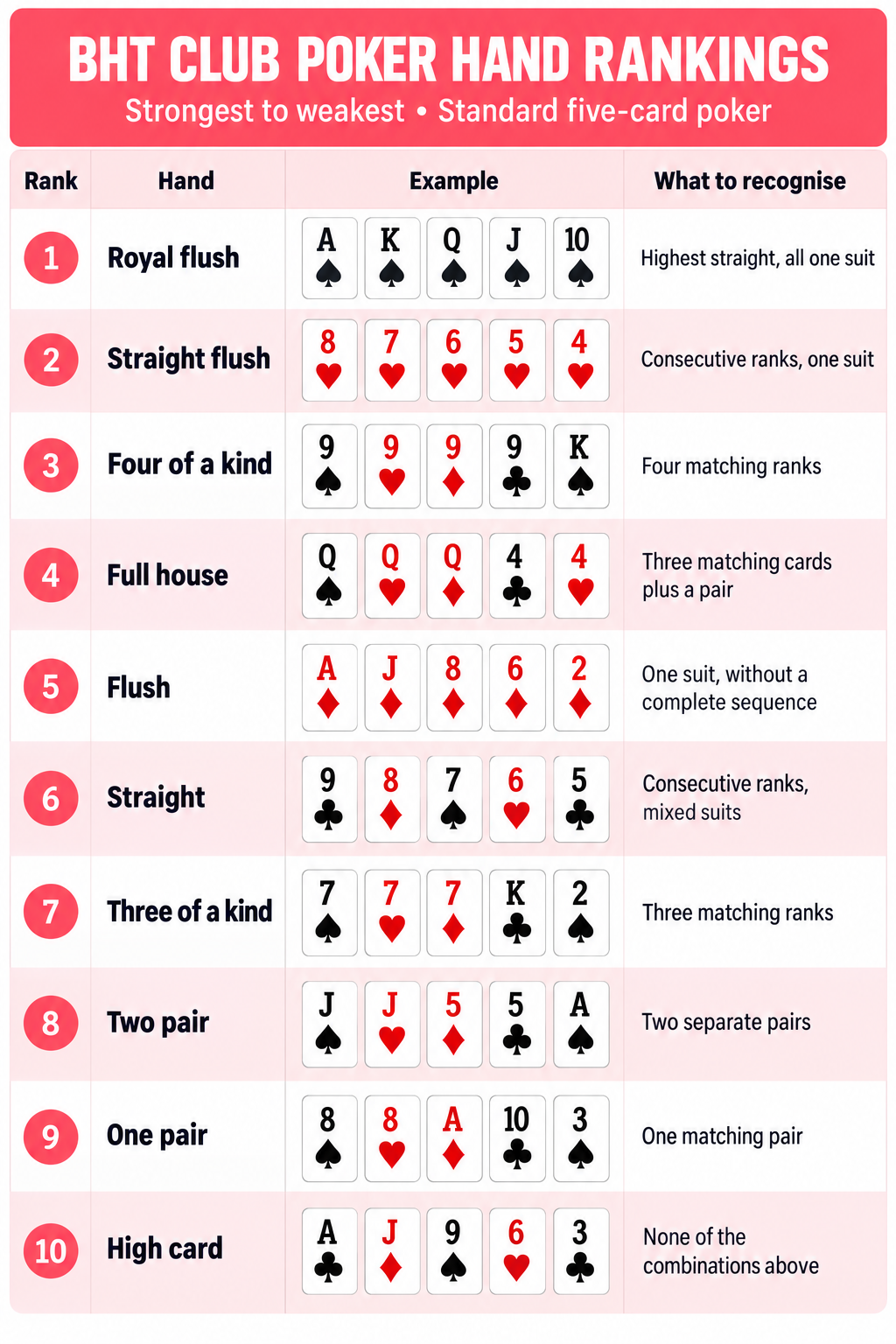
A royal flush is the highest possible straight flush, usually listed separately for easy learning.
Here, A means ace, K means king, Q means queen and J means jack. The symbols identify spades, hearts, diamonds and clubs.
Royal Flush: The Highest Possible Hand
A royal flush contains ace, king, queen, jack and ten, all in the same suit. It sits at the top of the standard ranking system.
For example, A♥ K♥ Q♥ J♥ 10♥ is a royal flush. Replace the ten of hearts with a ten of clubs and the hand becomes an ace-high straight instead. The matching suit is essential.
No higher standard hand can beat a royal flush. However, equal best hands can share a pot. In Hold’em, a royal flush on the five community cards gives every remaining player that same best hand.
For beginners, this is an easy anchor for the chart: the highest sequence and one matching suit together make the strongest combination.
Straight Flush: A Sequence in One Suit
A straight flush contains five consecutive ranks, all sharing one suit. The example 8♥ 7♥ 6♥ 5♥ 4♥ is an eight-high straight flush.
It beats four of a kind, full house and every lower category. When two straight flushes are compared, the one with the higher top card wins.
An eight-high straight flush therefore beats a seven-high straight flush. The suit itself does not provide an extra ranking advantage.
The lowest straight flush is A-2-3-4-5 in one suit. In that sequence, the ace works as the lowest card, making the hand five-high.
Check both parts of the combination: a full sequence and a single suit. Missing either part changes the hand category.
Four of a Kind: Four Cards of One Rank
Four of a kind, often called quads, means four cards share the same rank. Four nines with a king form a nine-ranked four of a kind.
The fifth card is the kicker. First compare the rank of the four matching cards. Four queens beat four jacks regardless of the remaining card.
A kicker matters when both players share the same quads, which can happen through the community cards in Hold’em. Suppose the board contains four sixes and a three. A player holding an ace can make four sixes with an ace kicker, beating an opponent whose best kicker is a king.
Only the best fifth card counts. There is no sixth-card tie-break.
Full House: Three Matching Cards and a Pair
A full house combines three cards of one rank with two cards of another. Q♠ Q♥ Q♦ 4♣ 4♥ is described as queens full of fours.
A full house beats a flush but loses to four of a kind. When comparing two full houses, look at the three-card group first.
Three tens with two twos beat three nines with two aces. The pair of aces may catch your eye, but the higher three-card group decides the comparison.
If the three-card groups match, compare the pairs. Queens full of fives beat queens full of fours.
This order prevents a common mistake: reading the highest individual card instead of the structure of the full house.
Flush: Five Cards of the Same Suit
A flush contains five cards of one suit without a complete consecutive sequence. A♦ J♦ 8♦ 6♦ 2♦ is an ace-high flush.
A flush beats a straight. This remains true even when the straight ends with an ace and the flush has a much lower highest card.
When both players have a flush, compare their five ranks from highest to lowest. If their highest cards match, move to the second highest, then continue as needed.
For example, A-J-8-6-2 beats A-10-9-7-3 as flushes because the jack beats the ten at the first difference.
Four cards of one suit are not a completed flush. They may form a draw when more cards remain to come.
Straight: Five Consecutive Ranks
A straight contains five consecutive ranks with more than one suit. Nine, eight, seven, six and five make a nine-high straight.
A straight beats three of a kind but loses to a flush. Compare the highest card when two players have straights. A ten-high straight beats a nine-high straight.
The ace has two possible positions: A-2-3-4-5 is five-high, while 10-J-Q-K-A is ace-high. The ace cannot join the middle of a sequence.
That means Q-K-A-2-3 is not a straight. You cannot wrap the sequence around from king to ace and continue through two.
Two equal straights tie even if the players have different unused cards. Every card in the five-card sequence already belongs to the completed hand.
Three of a Kind: Three Matching Ranks
Three of a kind contains three cards of the same rank plus two unmatched cards. Three sevens, a king and a two make three of a kind, sevens.
This category beats two pair. Three twos therefore beat two aces and two kings when those are the players’ best five-card categories.
Compare the three-card rank first. If it matches, compare the higher kicker and then the lower kicker.
In Hold’em, people often say “set” when a pocket pair combines with one matching board card, and “trips” when a board pair combines with a matching hole card. These describe how the hand formed. Both belong to the same ranking category.
Two Pair: Compare the Higher Pair First
Two pair means two cards of one rank, two of another rank and a fifth card. J♠ J♥ 5♦ 5♣ A♠ makes jacks and fives with an ace kicker.
Start with the higher pair. Kings and twos beat queens and jacks because kings outrank queens. You do not add the pair values together.
If the higher pairs match, compare the lower pairs. Kings and eights beat kings and sevens.
If both pairs match, the fifth card decides. Kings and eights with an ace beat kings and eights with a queen.
This comparison is especially useful when the board supplies a shared pair. Read the entire five-card hand before deciding which personal card matters.
One Pair: A Match With Three Supporting Cards
One pair contains two matching ranks and three unmatched cards. A pair of eights with ace, ten and three is a complete five-card hand.
A higher pair beats a lower pair. Two nines beat two eights even if the eights have an ace beside them.
When the pairs match, compare the three kickers in descending order. You may need the second or third kicker to find the difference.
For example, a pair of jacks with A-9-4 beats the same pair with A-8-7. The aces match, so the nine decides the result.
A high kicker can separate equal pairs, but it cannot promote a lower pair above a higher pair.
High Card: The Best Unmatched Hand
High card applies when your best five cards make no pair, straight, flush or stronger combination. An ace-high hand can beat a king-high hand within this category.
If the highest cards match, compare the next cards in order. Continue until a difference appears or all five ranks match.
For example, A-J-9-6-3 beats A-J-8-7-4 when neither hand forms another category. The first two ranks match, and the nine beats the eight.
High card is the lowest category, but it can still win against a lower high-card hand. A hand can also win without showdown when all opponents fold; the ranking chart explains comparisons when hands are actually compared.
Kickers, Ties and Split Pots
A kicker is a supporting card used to separate certain otherwise equal combinations. It matters only when included in the best legal five-card hand.
The simplest method is to name both categories first. If one category is higher, stop there. If they match, compare the important ranks for that category.
For pairs, compare the pair before the kickers. For full houses, compare the three-card group before the pair. For straights, compare the top card of the sequence.
If all five relevant ranks remain equal, the hands tie. Suits do not break standard poker hand ties. Spades are not automatically stronger than hearts.
At showdown, tied winners share the pot for which they are eligible, subject to the game’s pot and odd-chip rules. A player’s unused sixth or seventh card cannot create a winner.
This is the key to understanding BHT Club Poker winning hands: “same category” may still produce a winner, but “equal best five-card hands” produces a tie.
Choosing the Best Five Cards
Texas Hold’em
In standard Hold’em, two private hole cards and five shared community cards provide seven available cards. Make the strongest five-card hand using both hole cards, one hole card or neither.
You are not required to include your favourite starting card. If the board provides the best five cards, you play the board.
Suppose the board is A♣ K♦ Q♥ J♠ 10♣. Every remaining player can use that ace-high straight. A private pair does not improve it, and a private ace does not act as an extra kicker.
Omaha High
Standard Omaha requires exactly two hole cards and exactly three community cards. Its high-hand categories match the standard chart, but hand construction differs.
For example, four hearts on the board plus only one heart in your Omaha hand do not make a flush. You need the required combination of two private cards and three board cards.
These examples teach variant rules. Confirm the actual Bht Club game listed in your account before applying either method.
Worked Showdown Examples
The following examples show how BHT Club Poker card combinations should be read under standard Hold’em rules. They are illustrative deals, not reported platform results.
Example one: A flush defeats a straight
Board: 5♥ 6♥ 7♣ K♥ 2♠.
You hold 8♦ 9♠, giving you a nine-high straight. Your opponent holds A♥ 3♥, making an ace-high flush with the three hearts on the board.
The flush wins because its category is higher. The result is decided before comparing individual high cards.
Example two: The kicker matters
Board: Q♣ 7♦ 4♠ 2♥ 9♣.
You hold Q♥ A♦. Your opponent holds Q♠ K♦. Both have a pair of queens, but your best five cards include an ace kicker, while your opponent’s include a king.
Your pair of queens wins this comparison through the higher kicker.
Example three: The board creates a tie
Board: A♠ A♥ K♣ K♦ Q♠.
You hold J♣ 8♦. Your opponent holds 10♥ 7♣. Both best hands are the board’s two pair, aces and kings, with a queen kicker.
Your jack does not matter because it is outside the best five. The hands tie.
Example four: A shared three of a kind
Board: 8♠ 8♥ 8♦ 5♣ 2♠.
You hold A♣ Q♦. Your opponent holds A♦ J♣. Both players have three eights and an ace as their first kicker. The next kicker decides: your queen beats the opponent’s jack.
Neither player has a full house because neither available hand contains a separate pair. This example shows why identifying the category must come before comparing the supporting cards game.
Example five: A higher pair takes priority
Board: K♣ 9♦ 6♥ 3♠ 2♣.
You hold 9♠ A♥. Your opponent holds K♦ Q♣. Your ace looks strong, but your completed hand has a pair of nines. The opponent has a pair of kings.
Kings win before kickers are considered. The ace cannot override the higher pair, even though it is the highest individual card in your hand.
Learning the Hand Order Comfortably
The BHT Club Poker hand order becomes easier to remember when you group similar combinations. Begin with high card, one pair, two pair and three of a kind. Then learn straight and flush. Finally, add full house, four of a kind and the straight flush family.
Keep your practice focused on one comparison at a time. When you can explain the result in a short sentence, move to another example. Understanding why a hand wins is more useful than guessing its name quickly.
Use ordinary cards to build examples away from a paid table. Create a straight beside a flush and explain why the flush ranks higher. Then build two equal pairs and change the kickers.
This BHT Club guide is designed to make that learning welcoming. You can return to the chart whenever a comparison feels unclear, without needing to memorise everything immediately.
Bring Clarity to Every Showdown on Bht Club
The appeal of learning BHT Club Poker rankings is how quickly confusing card displays become readable. You recognise the category, select the correct five cards and compare the ranks in the proper order.
Keep the hands chart close while learning. Pay particular attention to flush versus straight, full-house comparisons and kickers, because these explain many seemingly surprising results.
A clear understanding makes following poker more enjoyable. Take your time with the examples, confirm your table’s rules and let accurate hand reading become a familiar part of your BHT Club experience.